Trends and Waves: Rolex Bubblebacks, or the Ovetto - Part 1
Written and photographed by K.S. (@mirror_ring), a Rarefied Seoul contributor.
Edited by Jay Chang
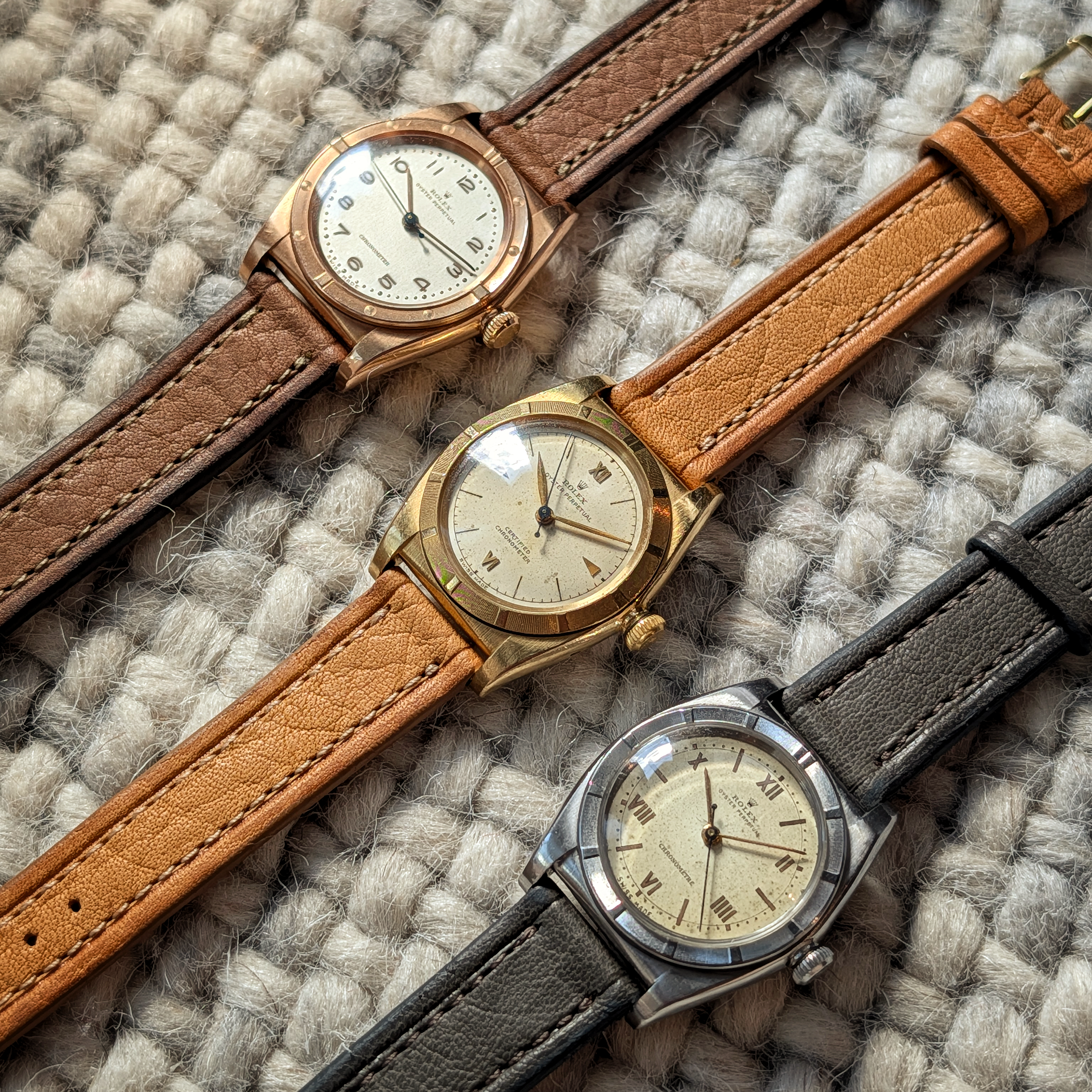
A trio of 1940s Bubblebacks showing the diverse range of case materials and dials. From the left: Rose Gold ref.3372, Yellow Gold ref. 4777, and Steel ref. 3372
As smaller watches continue to reclaim mindshare in horology circles, collectors — new and old — are revisiting the classics: the Cartier Tank, 1940s Patek Calatravas, and the original “hype” watch of the late ’80s and ’90s — the Rolex Bubbleback (affectionately known as the Ovetto in Italian circles).
Today’s article focuses on the core archetype: the first generation Oyster Perpetual — a time-only watch, in a 32mm case, powered by Rolex’s earliest automatic calibers 620 and 630, produced from the mid 1930s to the early 1950s.
Most collecting journeys have a gateway watch — the piece that opens the imagined futures of your horological horizons. Let me introduce you to mine: the ref. 3372, a 1947 rose gold Bubbleback.
So What Drew Me to This Particular Rolex?
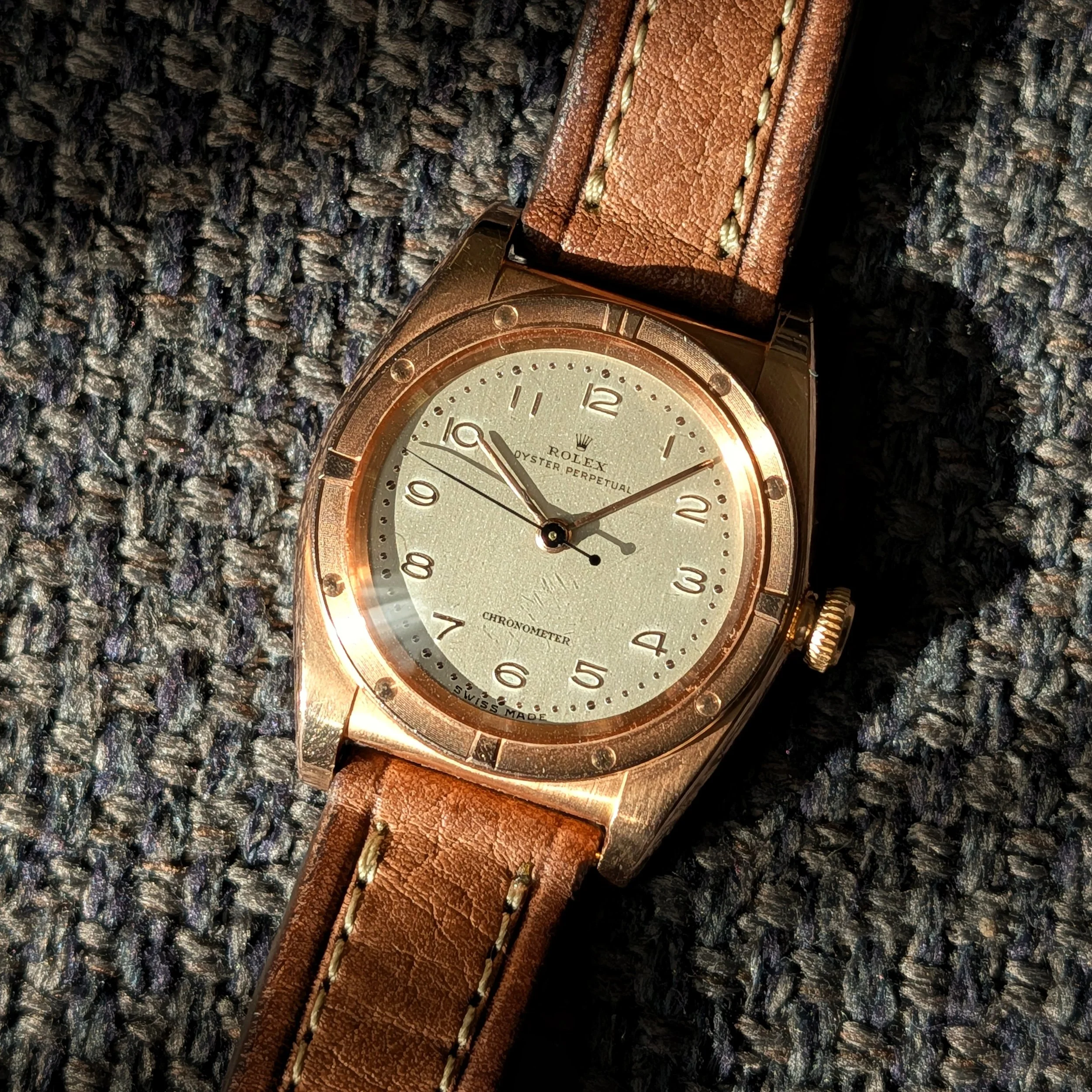
My Gateway Bubbleback - 18K rose gold ref. 3372 from the late 1940s
First is how well it wore despite its smaller size; something I could not really grasp until it was on my wrist. When I first held the watch in my hands, it looked small, even next to my Nomos Tangente. But once on my wrist, the measurements (32mm, 39.5mm lug-to-lug) faded away. It just felt right. And that is the Bubbleback effect: compared to many 1940s vintage watches — often thin, manually wound dress affairs — Bubblebacks carry more visual weight and wrist presence than you’d expect.
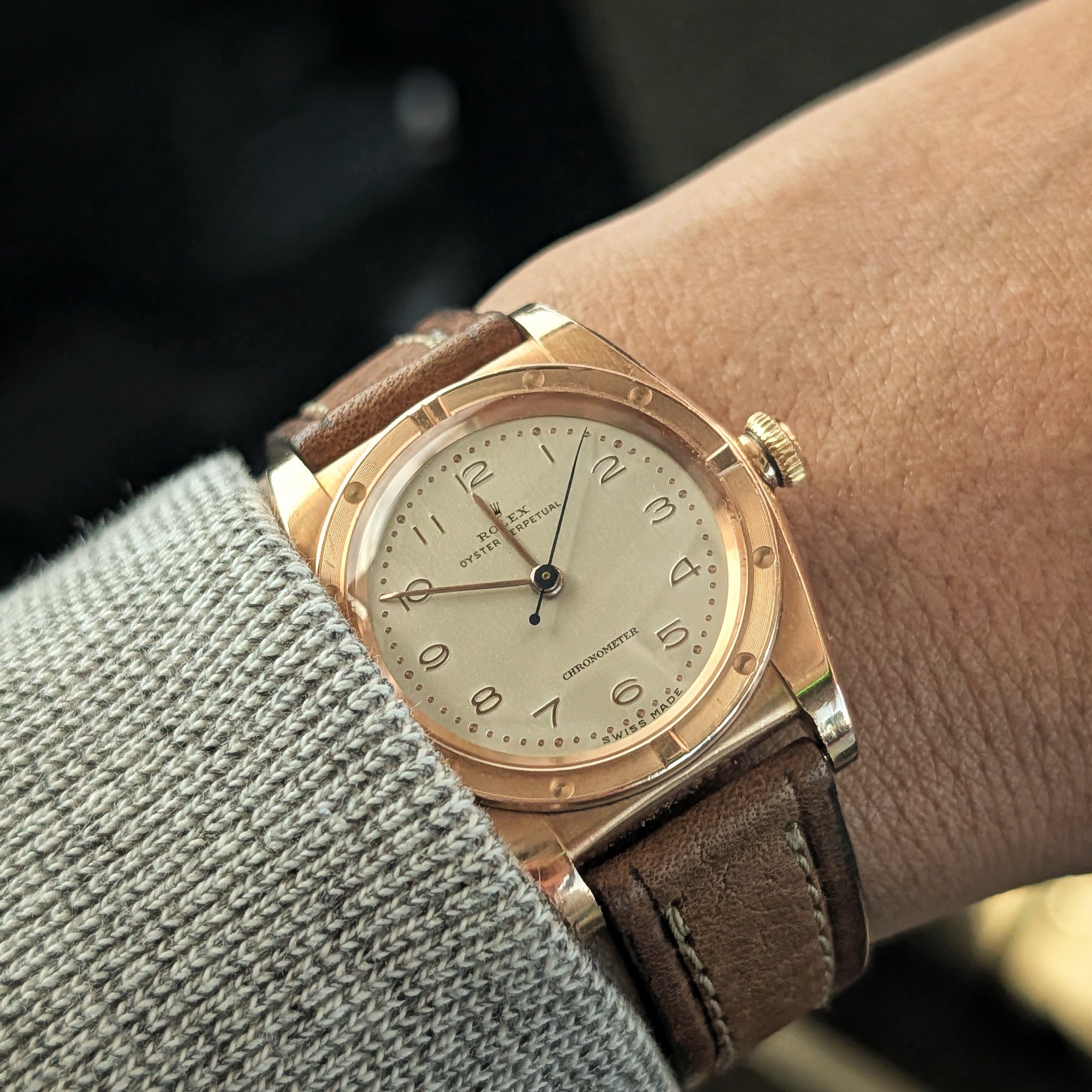
The Bubbleback ref. 3372 on a vintage-style strap
Second, vintage gold Bubblebacks were nothing like the gaudy gold Rolexes — President or Datejust — I had pictured. I used to find gold dated, even ostentatious. But the rosy hue of this piece stopped me cold when I brought it into the sunlight: pink gold with just enough coolness to stand apart from my skin, without the flashy yellow glare I had come to associate with vintage gold Rolex.
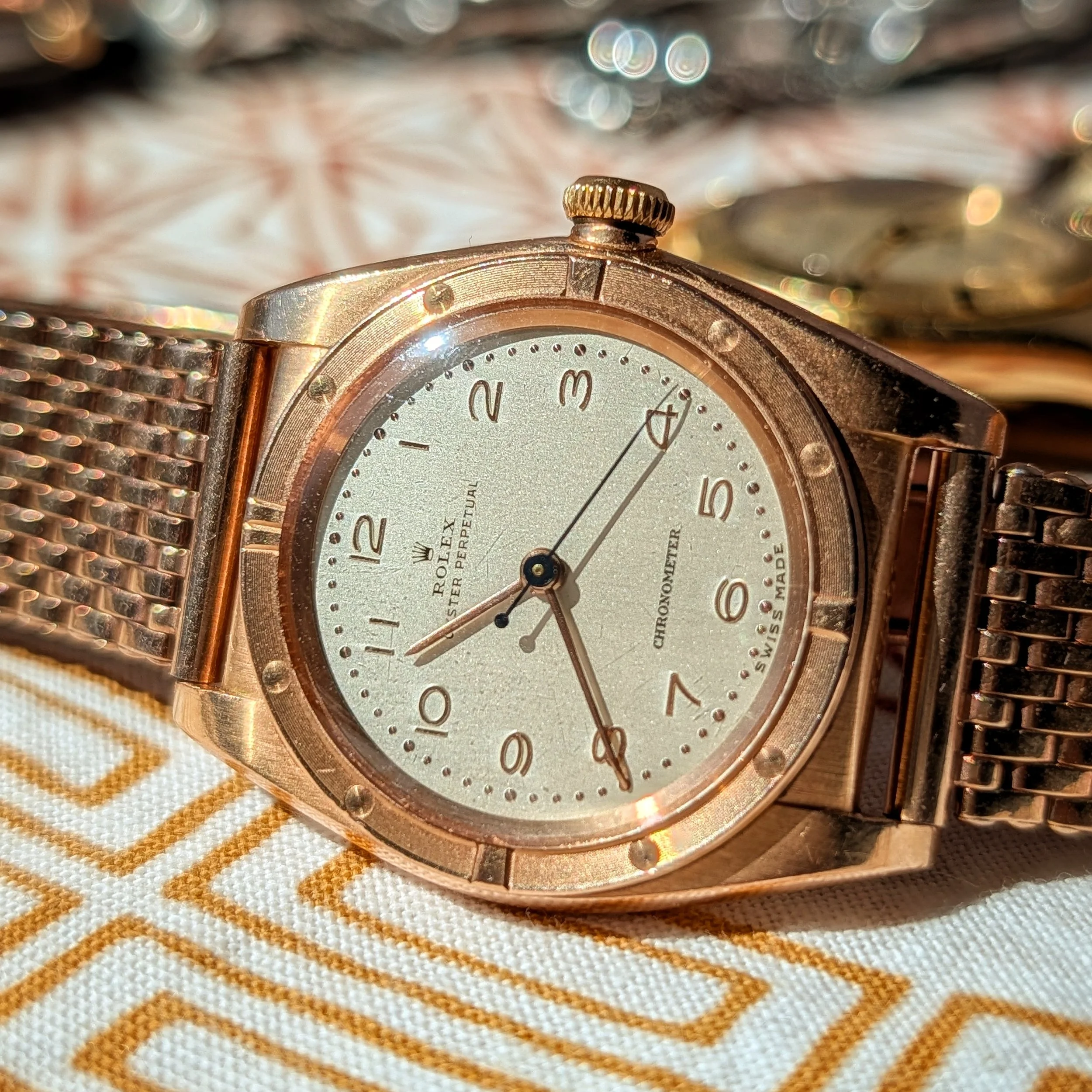
The Bubbleback ref. 3372 on a vintage beads-of-rice bracelet
Third, the clean design resonated with sophisticated execution. The thick bezel rose up from the midcase, adorned with a swirl of circular and angular elements. Describing the bezel as merely ‘engine-turned’ felt inadequate. The juxtaposition of the muscular midcase’s grained brushing with polished sides felt elevated, but not overwhelming. Light brought out the vertical grain of the silver dial with its thin, rose gold Arabic numerals. Only three lines of text sat on the dial, lending a sparseness and balance that feels rare today.
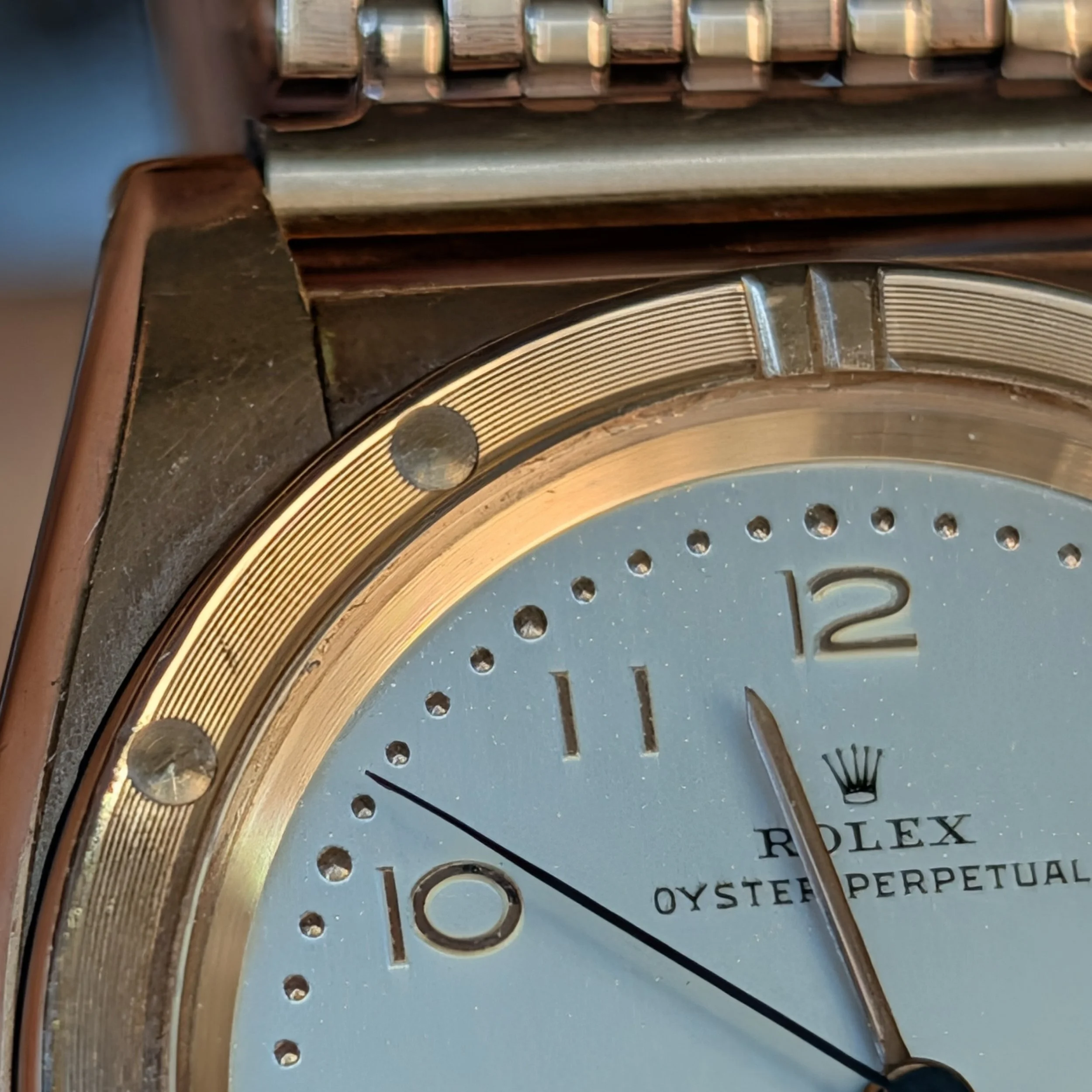
Close-up photo of the Ref. 3372 showing case brushing and engine-turned bezel details
When it comes to Bubblebacks, there are a lot of elements that could pull me in — and for me, the whole was greater than the sum of the parts.
The Significance of its Enduring Appeal
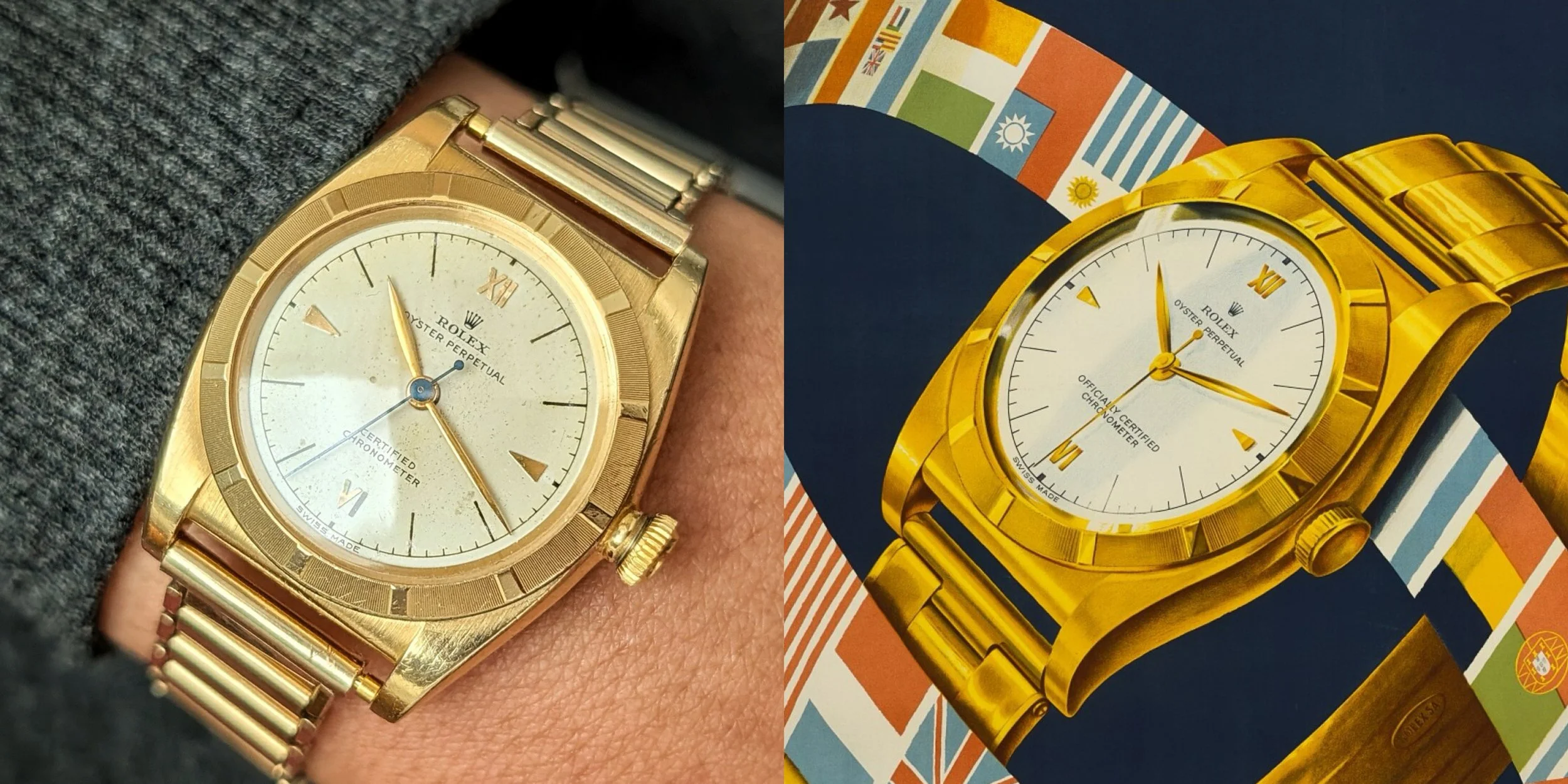
1940s Ref. 4777 compared to vintage Rolex Bubbleback poster of the same configuration
The Bubbleback sits at a crossroads of history, technology, and design. In its earliest years, you see the Oyster Perpetual blueprint taking form: a self-winding wristwatch built for daily wear, housed in an Oyster case meant to face the elements. That ambition carries it across three decades — each with its own eccentricities.
A 1930s Bubbleback feels almost high-end, carrying a refined air that is closer to classic dress watch language than to the musculature of later sports Rolex. By the 1940s, the visuals both tighten and broaden: creative flourishes abound, a clearer Rolex identity and typeface emerge, and the watch wears a bit slimmer, more resolved. Into the early 1950s, the design language begins its final shift — larger open dials, cleaner profiles, and details that foreshadow where consumer taste will go next. And the range is wide: Arabic or Roman, gilt or two-tone, sector or minimalist — there’s almost always a Bubbleback that will draw your eye and speak to your heart.
The Knowledge Gap
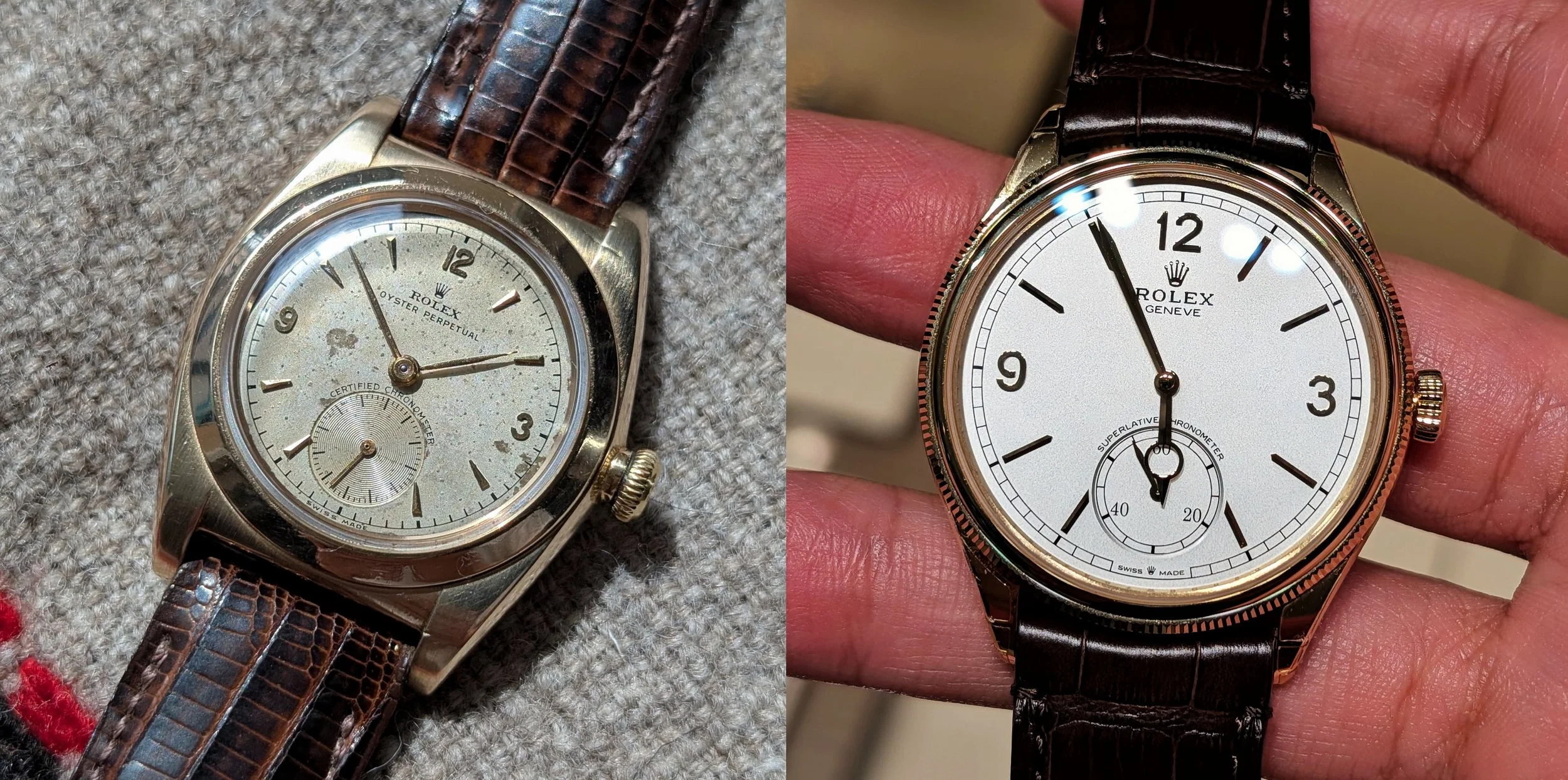
1940s Ref. 3131 Yellow Gold Bubbleback, which inspired Rolex's new 1908 Perpetual line
In the late ’80s and ’90s, Bubblebacks became the “hype” vintage Rolex, before fizzling out as prices fell back to earth. Though some strong examples were photographed, compared, and discussed across collector circles, this visual archive is only a partial record of Bubblebacks. The bench knowledge — parts, servicing, compatibility, and other idiosyncrasies — has always been harder to document, or even verify. And by 2026, it’s fair to say much of the original Bubbleback collector and servicing base has moved on — or passed away. The institutional knowledge was never captured online the way it has been for later vintage Rolex; the craze came and went before today’s watch communities truly formed. In the decades since, a small subset of collectors has continued to hold space for Bubblebacks, while the broader market moved on to larger steel Rolexes.
Sourcing is another challenge, and it’s heavily shaped by geography. Much of the best Bubbleback inventory has migrated into the hands of select European and Asian circles, and finding strong examples outside those ecosystems remains difficult. Last year, I spent a few days in Manhattan’s Diamond District, going shop to shop and asking around for Bubblebacks. I found only two examples — both refinished and grossly overpriced. Otherwise, my inquiries were met with bewilderment and blank stares.
It doesn’t help that many modern vintage Rolex dealers were raised on the online scholarship of steel sports models, and came of age in a world defined by early Submariners, Datejusts, and Daytonas. Bubblebacks fall just outside that default vocabulary.
All of this creates a knowledge gap, making Bubblebacks a promising — yet tricky — entry point for collectors.
Still, with patience, study, and a little help from Google Translate, you can hone your eye and take a step forward. Here's how I did it.
My Own Learning Journey
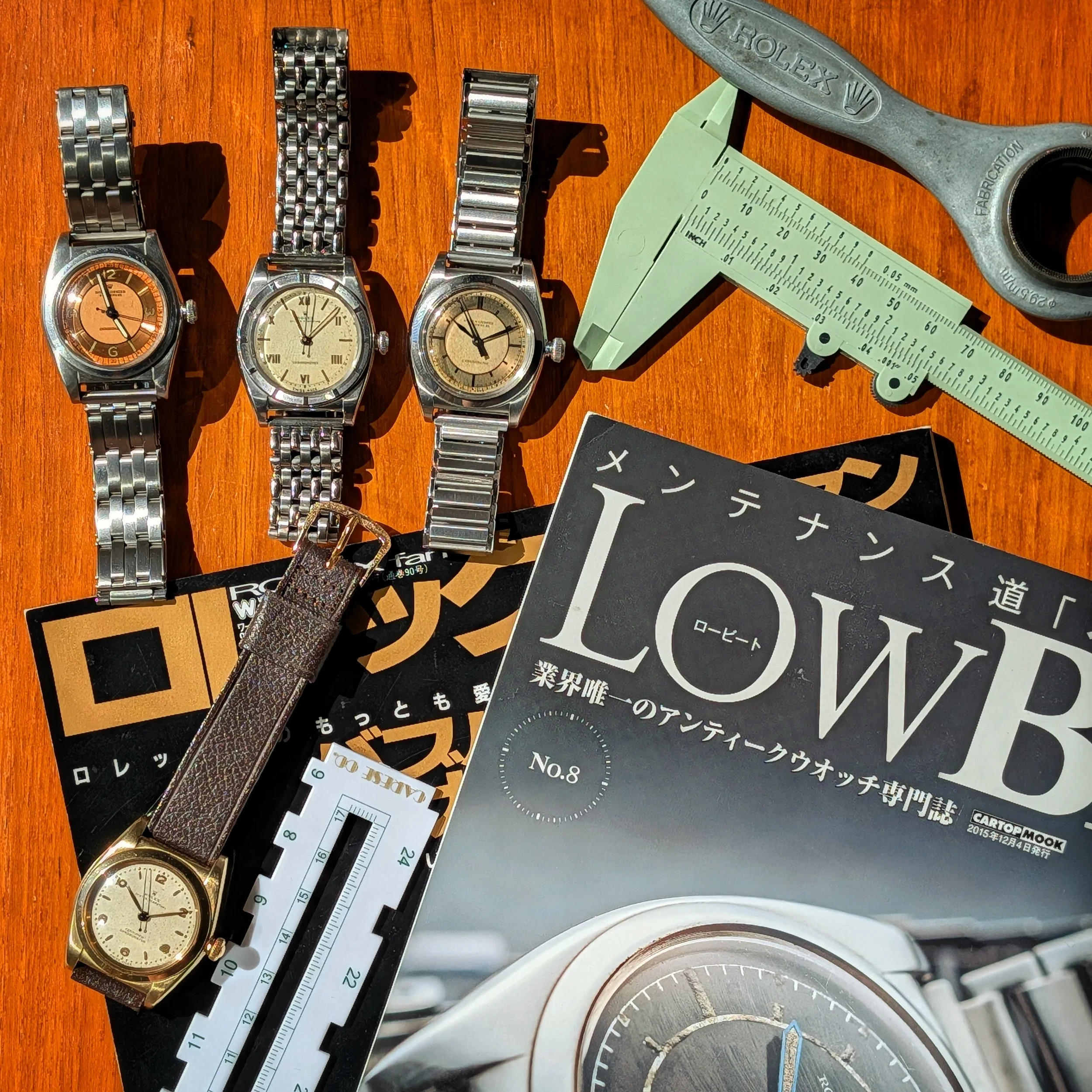
Some of the Japanese reference guides and tools from my learning journey
My collecting experience developed along two tracks.
First, I took a deep dive into what makes a “correct” Bubbleback. I started in watch forums and found mostly dead ends — references to long-gone threads and missing context. I moved on to dealer and auction sites and saw a clear lack of consensus on originality, dates, and even reference numbers. Eventually, I concluded that the best scholarship had to be in Japan. Thus, I tracked down obscure Bubbleback reference guides from the 1990s — imperfect compendiums made usable through scans and translation tools.
Second, as my mental model became clearer, I began buying. I was fortunate to handle and purchase original models from the late ’30s through the ’50s. That range — different dials, cases, and references — helped supplement my growing knowledge with confidence and taste.
A catalyst throughout this experience was my aforementioned gateway Bubbleback, the rose gold ref. 3372 — single-owner, original, and hardly worn timepiece. When you can start with a reference point that exquisite, it compels you to sharpen your instincts quickly.
And like most collecting arcs, progress doesn’t always feel linear. For every good purchase, there was an equally challenging one: frankens, counterfeits, problematic movements, refinishing. You make a few good decisions, get lucky once in a while, take some risks, and learn what you can’t unsee.
Where I Go Next
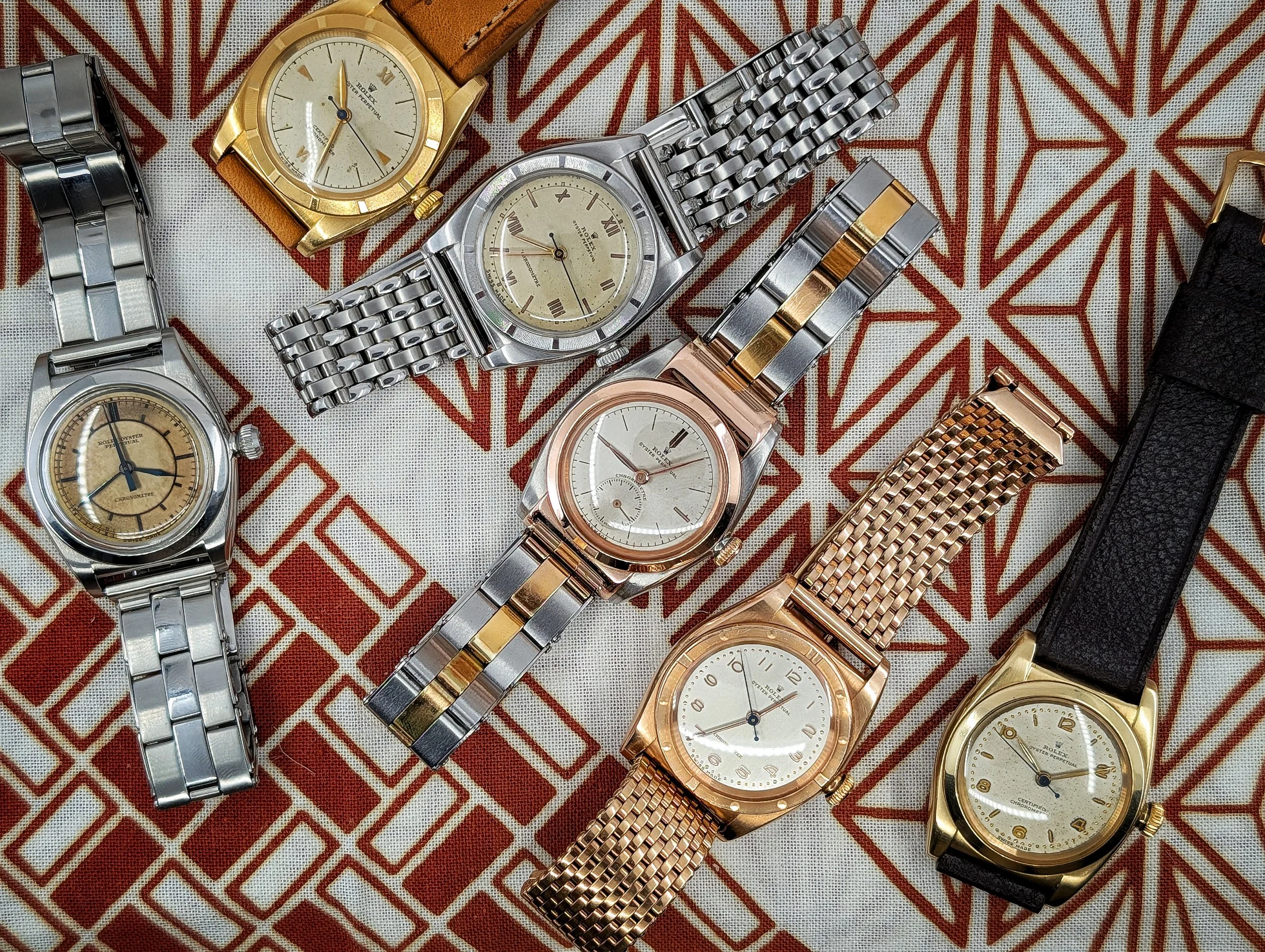
An assortment of six Oyster Perpetual Bubblebacks from the late 1930s to 1940s.
At this point, my sweet spot has become clear: early references with two-line dials — sometimes without a Rolex coronet — possessing qualities that feel out of step with modern Rolex. Art Deco influence. Steel and precious-metal cases. Unusual dial expressions like reverse gilt. These are the details that still stop me mid-Instagram scroll, even when I think I’ve seen them before.
Join me for Part 2, where I go through 3 very different Bubblebacks, and showcase some of the very unique elements that can make each piece so special.