Deep Dive: Patek Philippe Pocket Watch Sector Dial
In my fairly large watch collection consisting of more than 300 pieces, there are fewer than ten pocket watches. Over the years, I have tried to stay disciplined and intentionally avoided purchasing pocket watches except for a few special Longines examples that came my way. Nowadays, with the Rarefied Seoul museum in mind, I am more open to the idea of composing a small collection - consisting of no more than a couple dozen pieces - of pocket watches. At the helm of this transition is this newly acquired Patek Philippe pocket watch with an incredible two-tone sector dial.
With my limited experience, I am by no means an expert in pocket watches. However, when I first saw this piece, I quickly realised how special it was. Preserved in like-new condition, the watch features a 17-ligne lever escapement caliber. The extract from Patek Philippe confirms that the watch was manufactured in 1930, and subsequently sold on June 8th, 1939. The watch, purchased just before the onset of the Second World War, is seemingly totally unused.
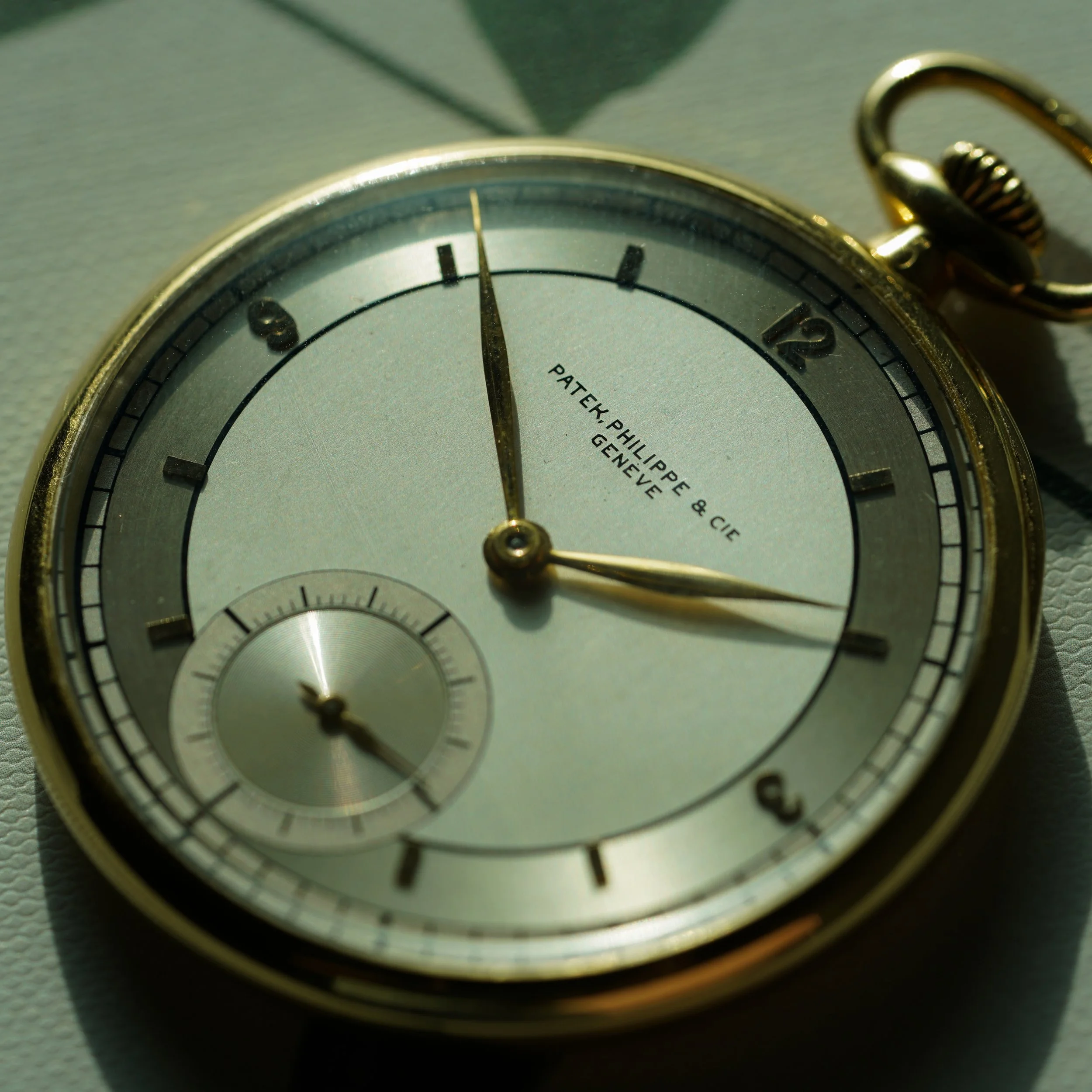
Patek Philippe pocket watch in 18k gold, with an incredible two-tone applied sector dial. The watch was manufactured in 1930, and sold in 1939.
In my early days of collecting, I was the most drawn to black gilt dials - the additional depth and three-dimensionality created by the galvanic process made the dial so much more interesting. Recently, I find myself more drawn to well-executed two-tone dials, especially those that switch between colours (white/silver and darker grey) or those that showcase different types of dial finishes. Such dials are best appreciated live, rather than through still pictures, and I truly enjoy wearing them on the wrist (and performing perpetual wrist-rolls while bored in the office).
Applied indices take such dials to the next level, as observed on this Patek Philippe pocket watch. The dial on this watch combines the two-tone effect (achieved through two different finishes on the dial) with applied sector indices featuring Arabic 3, 9 and 12. Throw onto this the iconic hard-raised enamel features and the result is a dial with incredible dimensionality and depth.
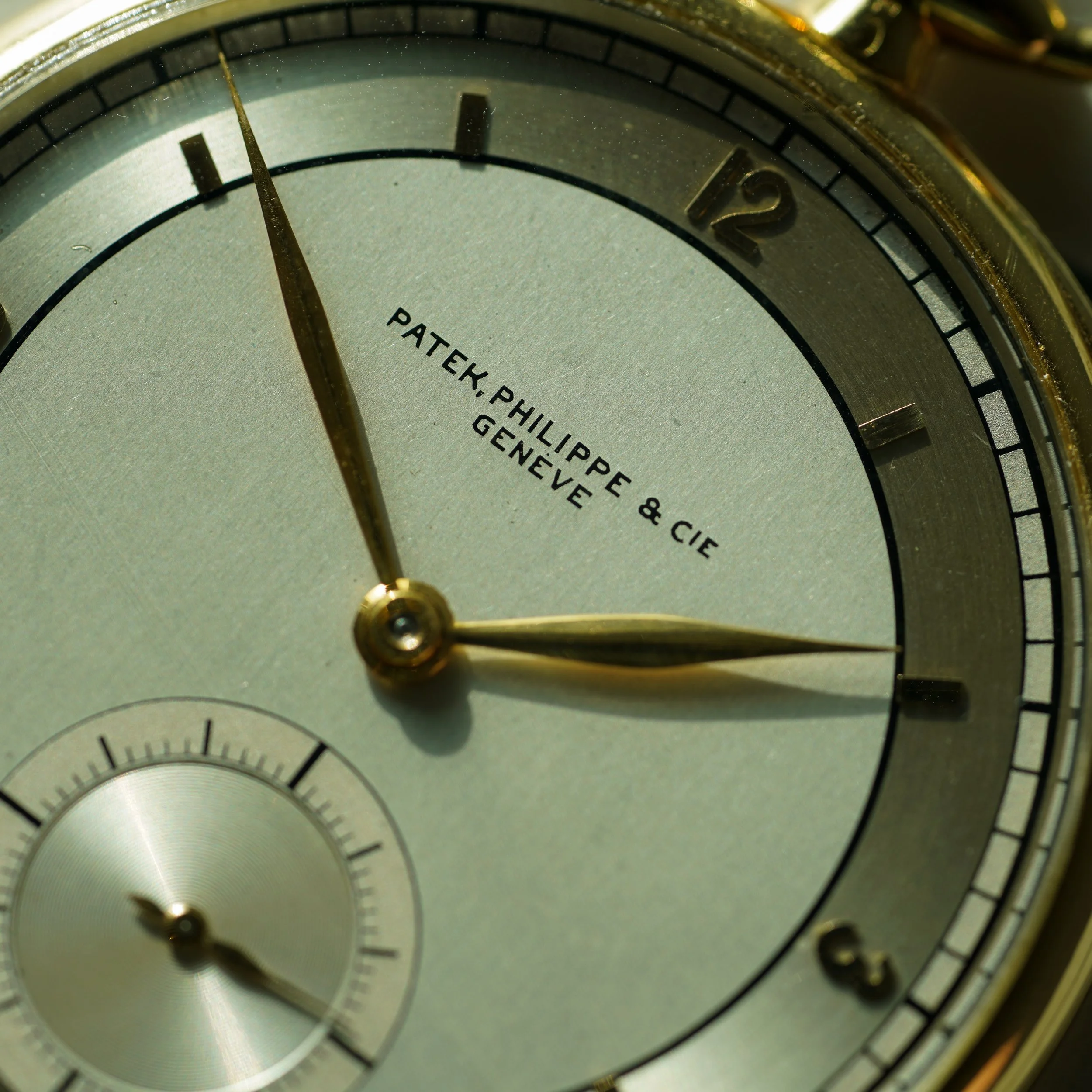
A close-up of the dial on the Patek Philippe sector dial pocket watch. The condition of the watch, manufactured in 1930, is truly astounding.
The important part - and what makes Patek Philippe of this era truly special - is that all this is achieved without being maximalist or overbearing. The watch is a truly exemplary exercise in aesthetic balance and execution - there is not one detail that is excessive and the different features complement each other to enhance the overall look of the watch. For example, the leaf hands - and a particular set at that, with slightly straighter edges and lines - contrast beautifully against the completely sharp lines and angles on the sector indices.
Perhaps it is a blessing that this is a pocket watch. In wrist-watch form, this dial would have simply been unaffordable for me (don’t get me wrong; I did not find this at a thrift shop for lunch money and paid more than I ever imagined I would for a pocket watch). Not only that, the larger dial diameter allows for more vivid lines and striking presence. The proportions are different on a pocket watch compared to those on a wristwatch, and I would argue this dial layout looks nicer as a pocket watch dial than it does as a wristwatch dial.
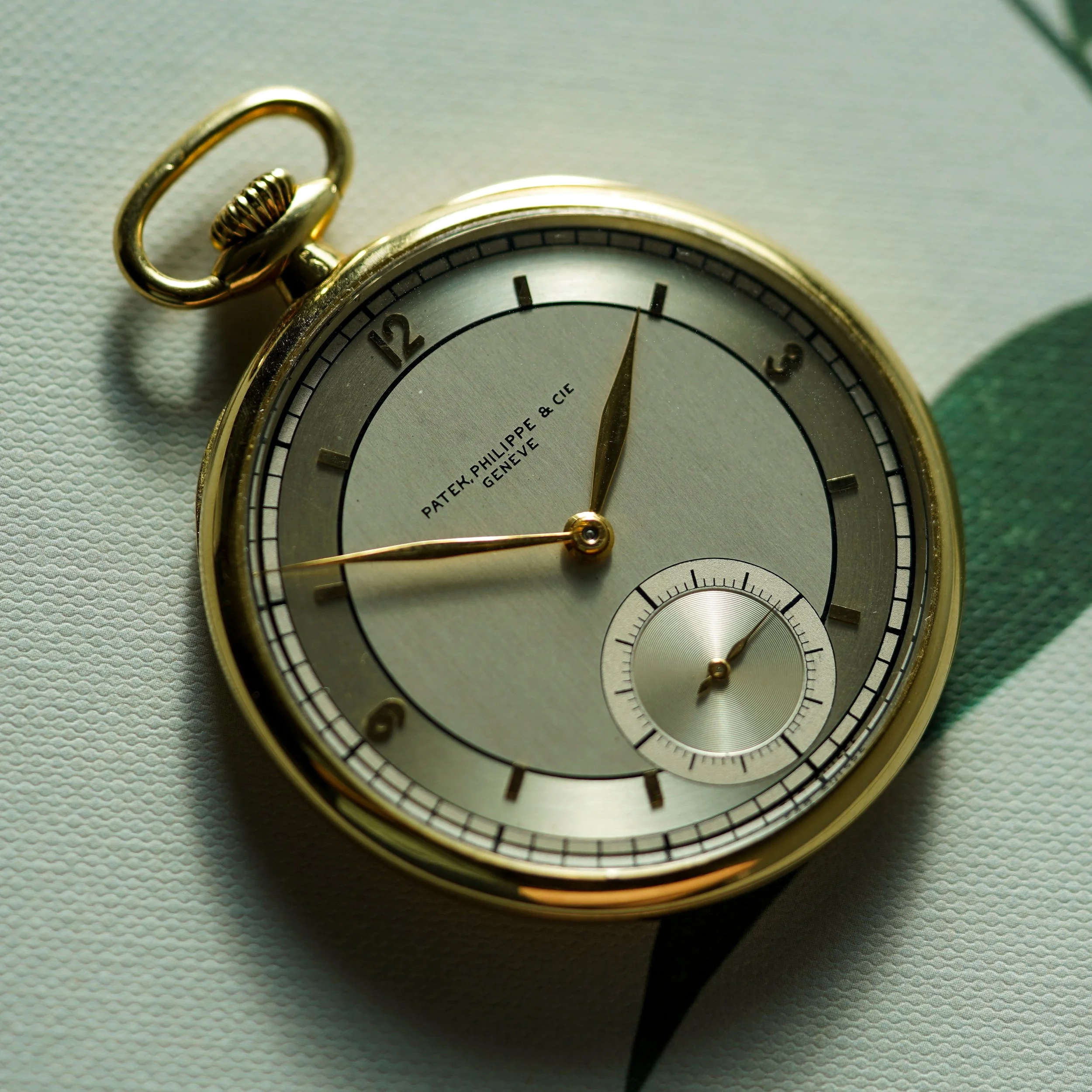
Another angle of the Patek Philippe sector dial pocket watch, accentuating the gold leaf hands. Every component of the watch is preserved in remarkable condition.
As much as I love wearing tailored clothing, I am not brave enough to actually use this watch as it was intended. Instead, I plan on exhibiting this watch - along with a few lovely pocket watches from Longines and Gubelin - in the Rarefied Seoul museum planned to launch in 2027. As the highlight piece in the pocket watch section, this Patek Philippe will maintain its fine state of preservation and serve as a time capsule for the future generations.